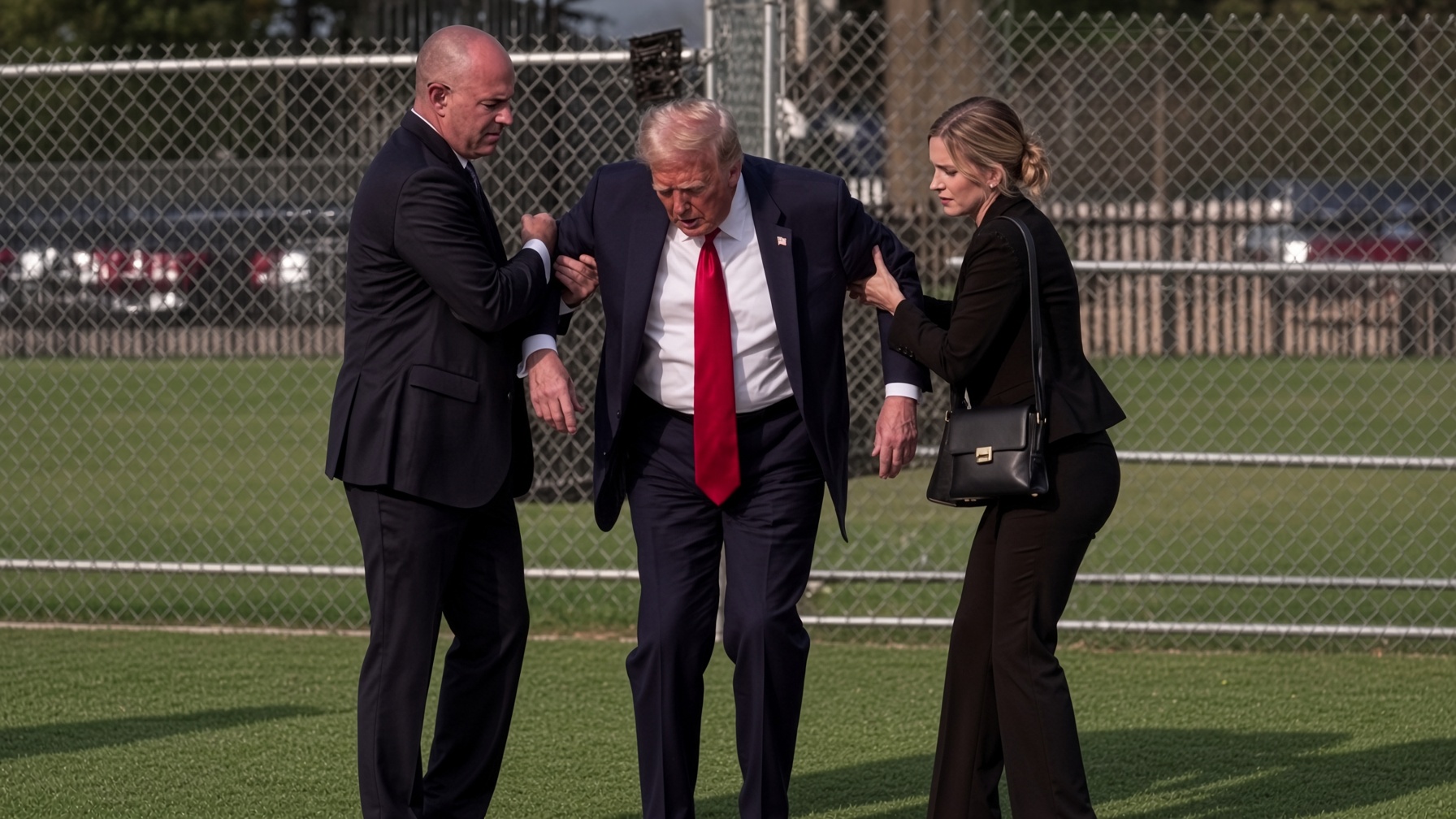
WASHINGTON — Unverified social-media posts alleging that President Donald Trump experienced a serious stumble while boarding an aircraft bound for Florida have renewed online discussion about his health, despite a lack of publicly available evidence confirming the reported incident.
The claims, which circulated across digital platforms, described an alleged balance problem during a presidential departure. Some posts connected the story to broader discussions about the war in Ukraine and potential diplomatic engagements involving Ukrainian President Volodymyr Zelenskyy.
However, the central allegations remain unsubstantiated. No authenticated footage, verified photographs, or independently corroborated reporting has been established in the information available for this report to confirm that Trump suffered a significant fall or experienced a medical emergency during the alleged incident.
The distinction between a viral claim and a documented event is particularly important when reports concern a sitting president, whose health can attract intense public attention and become a subject of political debate.
Alleged Incident Draws Attention Online
The online narrative reportedly gained traction as users shared claims about Trump’s movements near an aircraft and questioned whether the president had experienced a physical problem.
Some posts presented the alleged stumble as evidence of a potentially serious underlying condition. Others circulated interpretations of supposed footage or described details that were not accompanied by verifiable primary-source documentation.
Yet a claim’s popularity does not establish its accuracy. Without authenticated video, reliable eyewitness accounts, or confirmation from credible news organizations, the circumstances described in the posts cannot be treated as established fact.
Presidential travel typically involves journalists assigned to the traveling press pool, photographers, security personnel, and other officials who document departures and arrivals. Such records can help establish what happened during a particular event, although the absence of a published image or report does not, by itself, prove that an incident never occurred.
For now, the alleged stumble should be regarded as unverified rather than confirmed.
Claims About a Medical Whistleblower Remain Unsupported
The speculation expanded beyond the alleged physical movement after social-media posts began circulating claims that a presidential or military physician had disclosed a previously undisclosed neurological or cardiovascular diagnosis.
The posts reportedly suggested that a medical professional had broken protocol to reveal information about Trump’s condition. However, the allegations presented no independently verified medical documentation establishing that such a disclosure occurred.
The physician’s identity, the alleged diagnosis, and the circumstances of the purported disclosure have not been substantiated in the material provided for this report.
No authenticated clinical summary or independently confirmed statement from the alleged source has been established. Consequently, the claims do not provide a reliable basis for drawing conclusions about the president’s health.
Medical information about public officials can be a legitimate subject of public interest, particularly when it relates to their ability to carry out official responsibilities. Nevertheless, responsible reporting requires clear distinctions between confirmed medical information, official statements, anonymous allegations, and speculation circulated online.
Repeating an unverified diagnosis without credible supporting evidence risks turning an unsupported assertion into an apparent fact.
Why Short Video Clips Cannot Establish a Diagnosis
Medical professionals have long cautioned against attempting to diagnose complex health conditions solely from brief video clips or isolated photographs.
A single awkward step, a change in posture, or an apparent loss of balance can have numerous explanations. Lighting, footwear, uneven surfaces, fatigue, camera angles, and ordinary movement can all affect how a brief moment appears on screen.
Even when a physical incident is clearly documented, determining whether it reflects an underlying medical condition requires substantially more information than a short recording can provide.
Neurological and cardiovascular disorders are assessed through appropriate medical histories, physical examinations, and diagnostic testing when clinically indicated. A video viewed repeatedly on social media cannot substitute for that process.
The same caution applies to claims that a public figure has a particular diagnosis based on speech patterns, facial expressions, walking movements, or other isolated observations.
Without reliable medical evidence, outside observers cannot responsibly determine whether an apparent movement reflects an illness, a temporary physical difficulty, or an ordinary misstep.
Health Speculation Intersects With the Ukraine War
The rumors emerged against the backdrop of continued international concern over Russia’s war against Ukraine and debate about possible diplomatic initiatives, ceasefire arrangements, and future discussions involving Washington and Kyiv.
That context has helped draw attention to questions about presidential leadership, although no verified evidence establishes a connection between the alleged stumble and any diplomatic decision or national-security development.
The health of a sitting president is a matter of public interest because the office carries significant executive and national-security responsibilities. At the same time, speculative claims about a leader’s physical condition should not be confused with evidence about government policy, diplomatic negotiations, or military planning.
Analysts examining international affairs must rely on documented decisions, official communications, credible reporting, and other verifiable information rather than assumptions drawn from viral posts.
There is currently no substantiated basis for concluding that the alleged incident affected Trump’s official schedule or his handling of matters involving Ukraine.
Verification Remains Essential
The episode illustrates how quickly an unverified claim can spread when it involves a prominent political figure. Short clips, dramatic captions, anonymous accounts, and repeated reposting can create an impression of certainty even when the underlying evidence remains unclear.
Readers can assess such claims more carefully by checking whether the original footage is available, whether its date and location have been authenticated, and whether reputable news organizations or identifiable officials have independently confirmed the reported event.
Claims involving alleged medical disclosures require additional scrutiny. The existence of a post describing a whistleblower is not proof that the person exists, that the statement was made, or that the alleged medical information is accurate.
News organizations also have a responsibility to avoid presenting speculation as fact, particularly when a story concerns an individual’s health and the evidence is incomplete.
For now, the claims that Trump suffered a serious stumble while boarding an aircraft and that a physician disclosed a hidden diagnosis remain unverified. Without authenticated documentation or credible independent confirmation, neither allegation should be treated as an established event.
The broader lesson is straightforward: viral attention is not a substitute for evidence. In an environment where political narratives can spread rapidly, verified information remains essential to distinguishing legitimate public-interest reporting from online speculation.