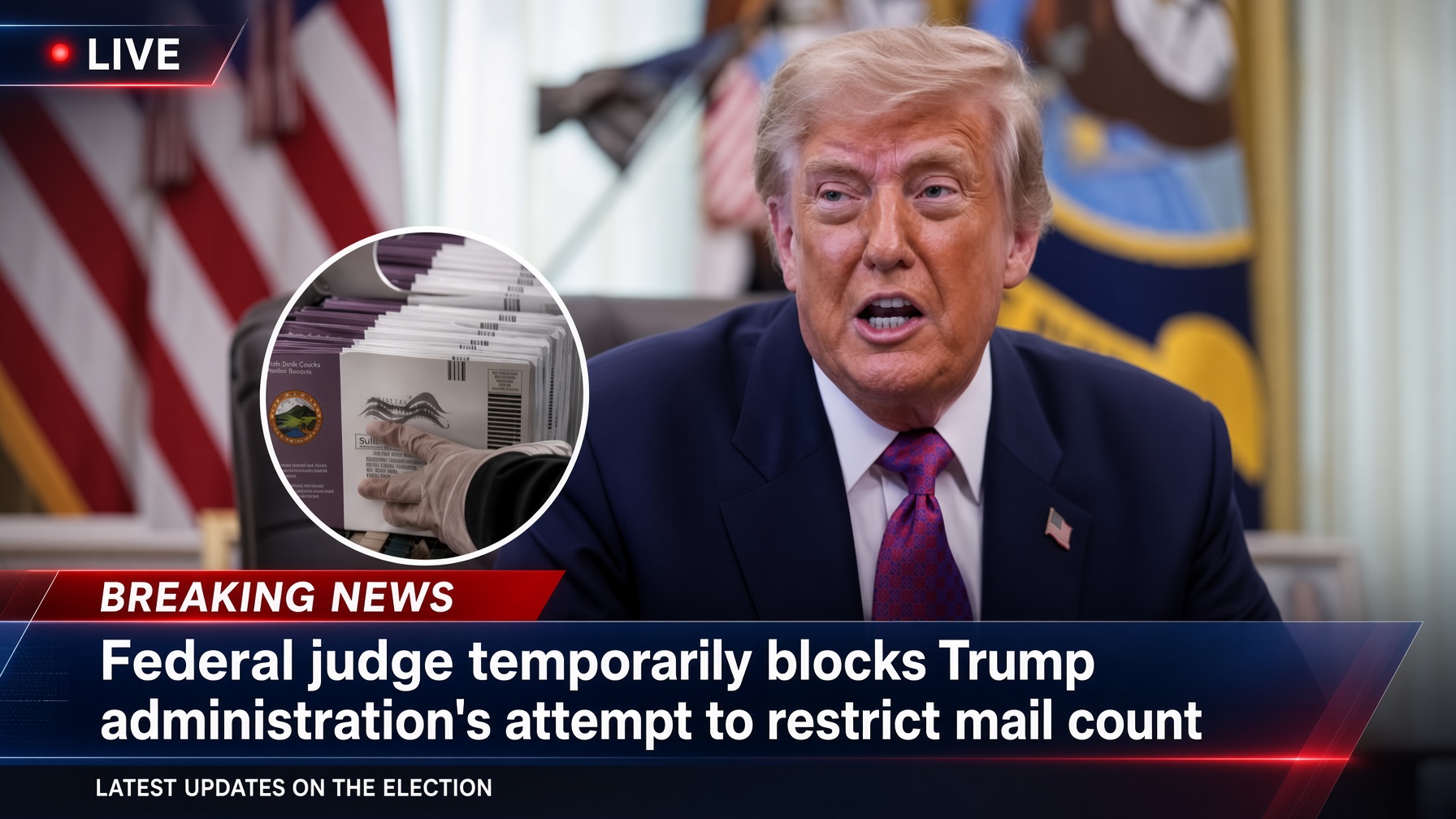
A federal judge on Thursday night blocked the Trump administration from implementing key provisions of a new rule restricting mail-in voting.
U.S. District Court Judge Indira Talwani issued a temporary order preventing the United States Postal Service (USPS) from increasing its oversight of mail-in voting. The order follows an executive order from President Donald Trump that would effectively make the Postal Service the primary enforcer of mail-voter eligibility.
Talwani blocked the newly finalized rule for at least 14 days.
The same judge had previously blocked Trump’s executive order but lifted that decision on Wednesday after the Supreme Court ruled Monday that she had initially acted too quickly.
With the judge’s latest order, the legal battle over the USPS rules is likely to eventually make its way back to the Supreme Court.
Dozens of Democratic state attorneys general sued the Trump administration over the USPS directive in April, arguing that it is unconstitutional because states—not the federal government—have primary authority over administering elections.
In a 6-3 decision Monday, the Supreme Court ruled that the states lacked standing to challenge Trump’s order at that stage because nothing had formally affected how they would administer elections. However, the high court did not weigh in on the legality of Trump’s order.
The judge’s latest order came after state attorneys general filed a new challenge following the USPS’s publication of a finalized rule governing the steps states must take to print ballots that are carried and tracked by mail.
In her Thursday order pausing the finalized USPS plan, Talwani wrote: “Plaintiff States face irreparable harm where they are required to comply with a likely unconstitutional regulation for which compliance is practically impossible as to the 2026 midterm elections, now little more than two months away.”
The new rules finalized by the USPS last week add verification requirements to all mail-in ballots, falling short of Trump’s expectations but introducing additional scrutiny.
Under the proposed changes, states would be required to collect and report basic voter information, such as a voter’s name and home address, linked to a unique barcode on every mail-in ballot distributed. Currently, there is no standardized requirement or method for states to track this information, leaving each state to independently determine how its mail-in voting system operates.
State election authorities would then be required to enter this information into a “federal ballot mail portal” before the ballot could be accepted into the mail stream.
The USPS said it would not deliver ballots from any state that failed to comply with the changes.
In a statement Thursday night, New York Attorney General Letitia James said: “This rule is a clear attempt by the federal government to interfere in elections it has no power to control. Today, a federal court halted it before this administration could wreak havoc on our elections. The USPS does not have the authority to decide who can and cannot vote by mail. My office will keep fighting to ensure this rule cannot disrupt our midterm elections.”
Trump issued an executive order in March seeking to restrict mail-in voting. The order directed the Department of Homeland Security to build a federal citizenship list and provide it to the states; the Department of Justice to target state officials who provide ballots to noncitizens; and the USPS to direct states to comply with certain mail-ballot design and tracking requirements.