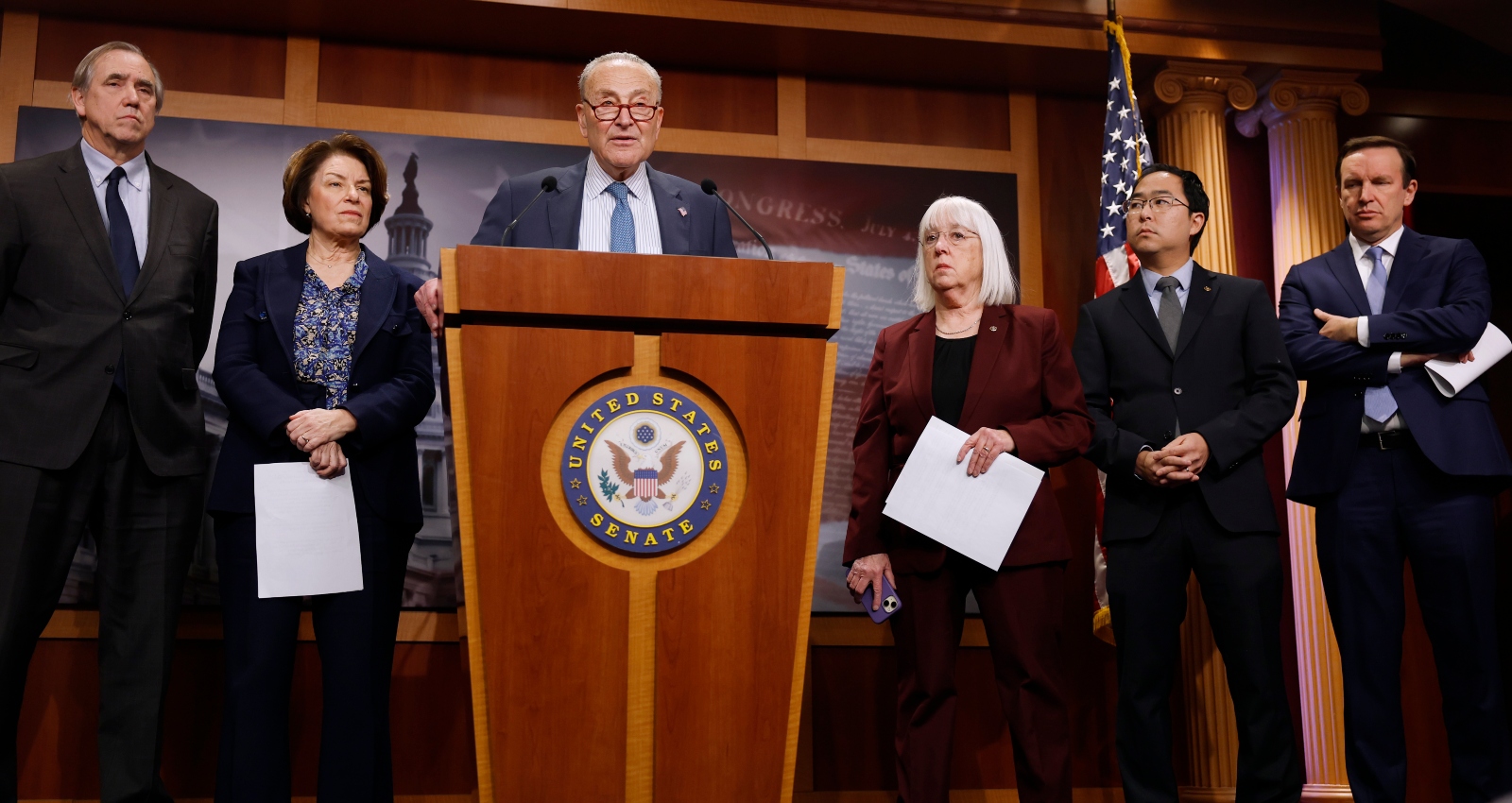
A noted Senate Democrat will miss several weeks of votes after a stroke, leaving his caucus short when lawmakers return Monday.
Connecticut Sen. Chris Murphy, 53, left Johns Hopkins Hospital on Friday, nearly a week after experiencing symptoms at his son’s hockey game.
His office announced the absence Friday as he left the hospital and prepared to continue recovery at a rehabilitation center.
Murphy said he called 911 after realizing something was wrong, and his office identified arm numbness as his initial symptom.
His chief of staff, Allison Herwitt, first disclosed the stroke on November 1, the day after Murphy was hospitalized.
Herwitt said Murphy was taken to a local hospital, where doctors determined that he had suffered a stroke.
He was then transferred to Johns Hopkins for monitoring, and Herwitt said he was awake, alert, and responding to treatment.
Murphy said Friday that doctors had identified a small bleed in the thalamus region of his brain.
Dr. Jose Suarez, chief of neurosciences critical care at Johns Hopkins, described the episode as a small hemorrhagic stroke.
Suarez said Murphy had made substantial progress and expected a full recovery if his improvement continued at its current pace.
“The doctors are very encouraged by the progress I’ve made so far,” Murphy said.
Murphy said he chose several weeks of rehabilitation to give himself the best chance of getting back to work promptly.
He thanked people who reached out to his family and acknowledged how frightening the experience had been for them.
The senator also thanked the Johns Hopkins doctors and staff who treated him and cared for his family.
Murphy said he would keep in touch with his staff and Senate colleagues remotely during rehabilitation.
He said his office would continue serving Connecticut constituents and working on its legislative priorities while he recovered.
The statement gave an expected duration for rehabilitation, while leaving the precise date of his return to Senate votes open.
The Senate’s published schedule calls for lawmakers to convene at 3 p.m. Eastern on Monday, November 9.
The chamber last met Thursday morning for a pro forma session, according to the Senate’s floor schedule.
Monday’s session comes after the midterm elections and falls within the current Congress, which runs until January 3.
Republicans hold 53 seats in the current Senate, according to the chamber’s official party breakdown.
The Democratic bloc holds 47 seats, including 45 Democrats and two independents who caucus with them.
With Murphy absent, that bloc would have 46 senators available if every other member attended.
The difference could matter on nominations and other simple majority votes if Republicans split or other senators are absent.
The Senate takes votes on amendments, motions, resolutions, bills, nominations, and treaties, with different thresholds applying to different questions.
On most measures, the Senate’s voting guidance says a simple majority is sufficient for passage.
When senators split evenly on a vote, the vice president may cast the deciding vote.
Republicans can use their current majority to advance nominees when their members remain united and attend the vote.
On a contested nomination, attendance and defections can determine how much room either party has to maneuver.
On some votes, a single absence can determine whether the vice president is needed to break a tie.
Ending debate on most legislation requires three-fifths of senators duly chosen and sworn, or 60 in a full Senate.
Murphy remains a sitting senator during rehabilitation, so that usual threshold remains 60 while he is away.
Senate leaders can therefore face different vote thresholds for ending debate and passing a bill.
That distinction will matter if senators return to closely divided legislative business during Murphy’s recovery.
Murphy began his third Senate term in January 2025, after winning reelection to represent Connecticut in Washington, Breitbart News reported.
His assignments for this Congress include seats on the Senate Appropriations, Foreign Relations, and Health, Education, Labor and Pensions committees.