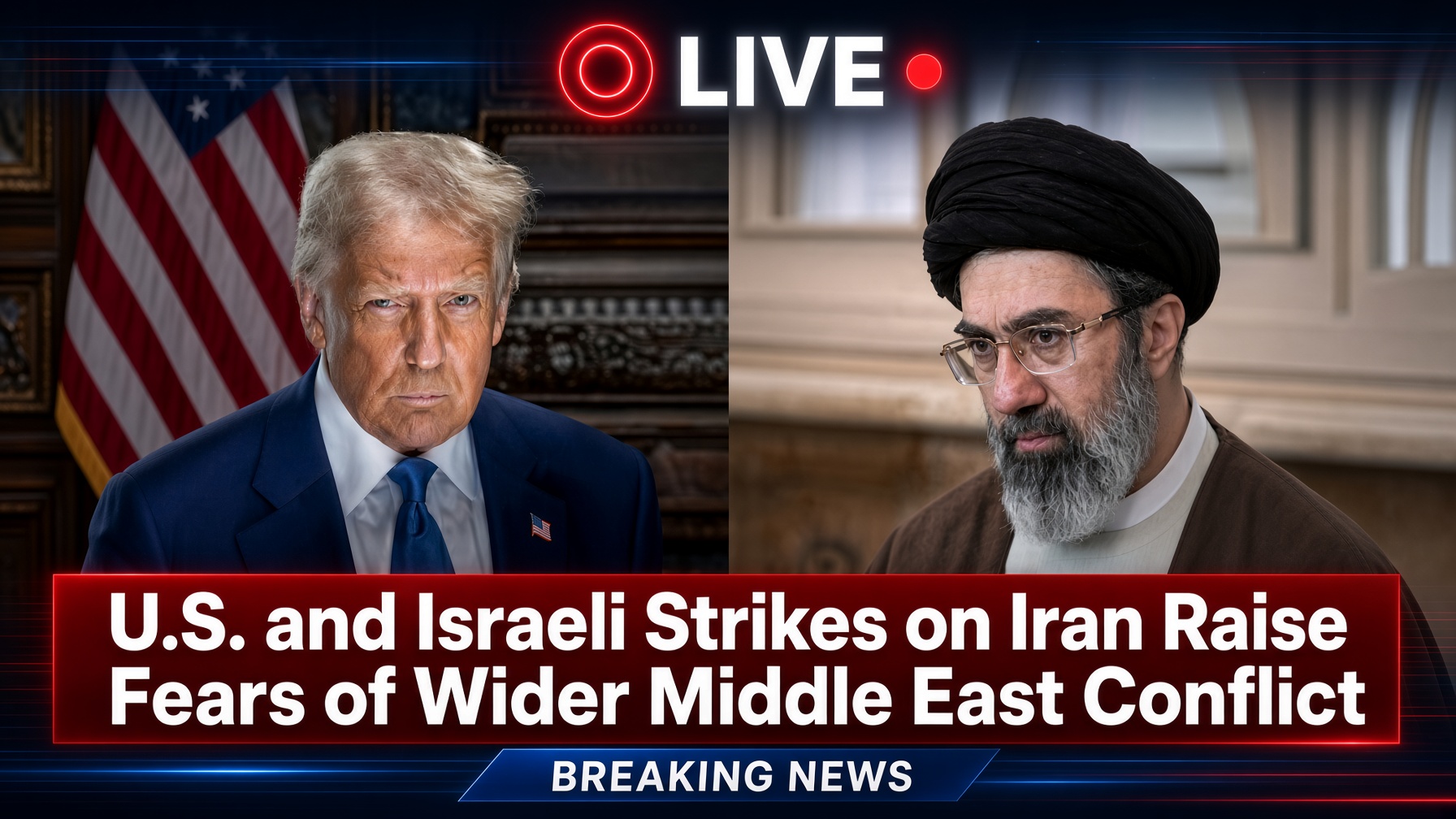
TEHRAN — Reports of a major wave of U.S. and Israeli military strikes against targets inside Iran have dramatically escalated tensions across the Middle East, prompting growing concern that the confrontation could develop into a broader and potentially prolonged regional conflict.
According to the account provided, the strikes focused on sites linked to Iran’s military and nuclear infrastructure. U.S. and Israeli officials described the operation as an effort to weaken capabilities they regarded as significant security threats and to reduce Iran’s ability to conduct future attacks.
The reported campaign, identified in the account as Operation Epic Fury, involved attacks on strategically important locations, including air-defense installations and other military infrastructure. Images and videos circulating online appeared to show destruction at several sites, although the extent of the damage and the circumstances surrounding individual strikes could not be independently verified from the information provided.
Iran Warns of Retaliation
Iranian authorities responded forcefully to the reported attacks, with state media describing the strikes as a major assault on the country. Iranian officials also claimed that air-defense systems had intercepted some incoming threats.
Iranian leaders warned that retaliation would follow, raising fears of a potentially dangerous cycle in which each new attack prompts another military response.
The prospect of sustained exchanges between the United States, Israel and Iran has placed governments throughout the region on heightened alert. European and other international officials have called for restraint, warning that continued escalation could destabilize neighboring countries and draw additional actors into the confrontation.
Strait of Hormuz Under the Spotlight
One of the greatest concerns involves the potential impact on global energy markets.
Iran’s proximity to the Persian Gulf and the Strait of Hormuz makes any military escalation particularly sensitive. The strategically important waterway serves as a major route for international energy shipments, meaning a serious disruption could affect oil prices, commercial shipping and economies far beyond the Middle East.
Even the threat of disruption could create uncertainty in global markets as governments and businesses assess the potential consequences of a prolonged conflict.
Civilians Face Growing Uncertainty
While military officials focus on strategic objectives, civilians across the region are confronting the immediate consequences of escalating tensions.
Residents in Iranian cities have reportedly monitored emergency warnings and prepared for the possibility of additional attacks. In Israel, communities remain concerned about potential Iranian retaliation and the possibility of further missile or drone attacks.
For families living near military installations or other potential targets, the conflict has become a matter of immediate personal safety rather than distant geopolitical strategy.
A Critical Moment for Diplomacy
The latest escalation presents an increasingly difficult challenge for international diplomats. Supporters of the military action may argue that the strikes are necessary to weaken Iran’s capabilities, while critics warn that every additional attack increases the possibility of retaliation and an uncontrollable escalation.
The central question now is whether the reported strikes represent a limited military operation or the opening phase of a much larger confrontation.
Much will depend on Iran’s next response, the subsequent actions of the United States and Israel, and whether diplomatic channels can prevent the situation from expanding.
For now, the Middle East remains on heightened alert. The coming days could prove critical in determining whether the latest confrontation is contained or develops into a wider regional crisis.